Staircase Wall Art: What Actually Works in 2026
Staircases eat wall space no other room in the house offers — tall, narrow, viewed from three or four angles, and usually lit worse than everywhere else. This guide covers what actually works on a stairwell wall and which pieces from Gioia Wall Art hold up at height in 2026.
- Roam is the safe staircase wall art pick for a single vertical anchor — Buy.
- Still Together works as a rising gallery run along the stair angle — Buy.
- Lined Up Style A reads well from both the top and bottom landing — Consider.
- Skip glossy framed glass on stairwells lit by a window; glare ruins sightlines from below.
- Grouped sets outperform single oversized canvases on sloped stairwell walls in most 2026 home layouts.
Why this matters
A staircase wall gets seen in motion, not from a couch. You pass it going up, glance at it going down, and catch it from the entry below — three different viewing distances on one wall. Most wall art is designed for a single fixed sightline, which is exactly why so much staircase decor ends up crooked-looking or lost against 9-to-12-foot ceilings.
High ceilings compound the problem. A piece that reads as generous proportion in a living room looks like a postage stamp once it's 15 feet up a stairwell. Get the scale and format wrong here and you'll notice it every single day, twice a day, on the way up and down.
Gioia Wall Art's curated wall art catalog includes enough vertical-format canvases and multi-piece sets to solve for stairwells specifically — the trick is picking the right shape and hanging pattern, not just a piece you like.
Who this is for
This guide is built for homeowners and renters dealing with a stairwell wall taller than 10 feet, a switchback or straight-run staircase with a visible ascending wall, or a foyer/stairwell combo where the art has to work from the front door and the second-floor landing at once. If your stairwell is a standard 8-foot single flight with no dramatic height, most of the sizing math below still applies — you just have more margin for error.
What to look for in staircase wall art
Vertical proportion over square canvases
A staircase wall is tall and narrow, so a square or landscape-format canvas gets swallowed by empty space above and below it. Portrait-oriented pieces or stacked/gallery sets follow the rise of the stairs and fill the vertical run instead of floating in the middle of it. This matters more on stairwells than in any other room in the house.
Sightline from two floors, not one
You'll view stairwell art from the bottom landing looking up and the top landing looking down — two completely different distances and angles. A piece with fine detail that reads beautifully up close can turn into a blur from 15 feet below. Bolder shapes, higher contrast, and simpler compositions survive both distances; intricate line work often doesn't.
Grouped sets over single oversized canvases
Sets of 2 or 3 canvases hung in a rising diagonal, following the pitch of the staircase, are far more forgiving than one giant canvas centered on an odd-shaped wall. A single large piece needs a wall with clean, even proportions on both sides — stairwells rarely have that. A staggered set adapts to the slope and to whatever trim, outlets, or handrail brackets interrupt the wall.
Frame finish and glare control
Stairwells often sit near a window or skylight for natural light, and that same light bounces straight off glossy glass frames when viewed from below. Matte canvas prints or framed pieces with anti-glare glazing hold up in this light; glossy acrylic glass frames tend to throw a white streak that's visible from the base of the stairs.
Weight and hanging hardware for high walls
Hanging anything above 8 feet means a ladder, a stud finder, and hardware rated for the actual weight — this isn't a spot to eyeball a nail into drywall. Canvas prints are lighter and more forgiving on this front than framed glass pieces, which is one more reason canvas sets dominate stairwell recommendations.
Color that holds up against low light
Stairwells are frequently the dimmest hallway in the house, especially on interior staircases with no direct window. Deep, high-contrast palettes and warm tones photograph and read better in low light than pale, low-contrast pastels, which can go nearly invisible by early evening.
“If you can touch the frame from the stair tread, it's hung too low for a staircase wall.”
Top picks for staircase wall art
Roam — the safe pick. This is a single vertical-format piece, which makes it the lowest-effort option if you don't want to plan a multi-piece layout. It works as a standalone anchor centered on a straight-run stairwell wall with at least 3 feet of clearance on either side. Buy if your stairwell has one clean, uninterrupted wall segment. Roam is the pick for exactly that scenario.
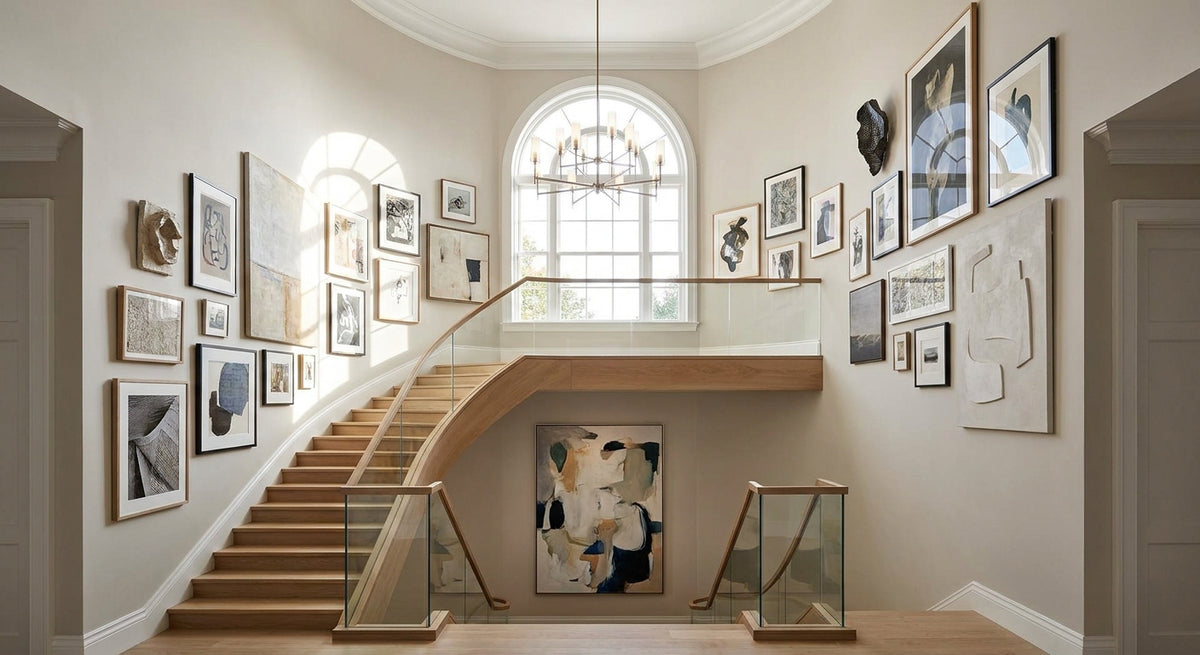
Still Together — the storyline piece. Hung as a rising sequence following the stair pitch, it reads as a narrative from bottom landing to top landing instead of a static wall decoration. This only works if you commit to angling the hanging line with the staircase rather than hanging level — do that and it becomes the piece people stop and look at on the way up. Buy for stairwells with a visible diagonal run of at least 8 feet. Still Together fits that brief.
Lined Up Style A — the two-floor test winner. Its bolder linework holds up from both the ground-floor entry and the upstairs landing, which is the exact double-sightline problem most stairwell art fails. Consider it if your staircase is visible from two separate levels of the house, which is common in split-level and center-hall layouts. Lined Up Style A is built for that dual view.
Between The Lilies — the soft filler. This is a quieter piece best used as the second or third canvas in a staggered group rather than a standalone statement. On its own it can disappear against a tall wall; paired with a bolder anchor piece, it balances the grouping. Consider only as part of a multi-canvas layout, never alone on a high wall.
Croissant At Caffe De Flore — the wildcard. It's a warmer, more personality-driven scene that works if your stairwell doubles as a gallery-style entry statement rather than a neutral backdrop. It's a strong choice for a foyer-adjacent stairwell where you want a conversation piece, but it's too specific in tone to work in every home. Consider for eclectic or maximalist interiors; Skip if your stairwell decor is meant to stay neutral.


What to avoid
- Oversized single canvases centered on an angled wall. Staircase walls are rarely symmetrical once you factor in the handrail, and a centered giant canvas exposes every inch of that asymmetry.
- Glossy framed prints near a stairwell window. They look premium in a showroom photo and throw glare from the exact angle you'll view them from the bottom stair.
- Delicate, fine-detail pieces at height. Botanical line drawings and thin ink work look intricate up close but vanish into a smudge from 15 feet below — save those for eye-level walls, not stairwells.
Stairwells near an entry get double duty as a first-impression wall too — worth reading the separate guide on entryway wall art for a strong first impression if your staircase opens straight off the front door.
Verdict comparison
| Pick | Format | Best sightline | Verdict |
|---|---|---|---|
| Roam | Single vertical canvas | One clean straight wall | Buy |
| Still Together | Rising sequence | Diagonal 8ft+ run | Buy |
| Lined Up Style A | Bold single/pair | Two-floor viewing | Consider |
| Between The Lilies | Grouping filler | Paired only | Consider |
| Croissant At Caffe De Flore | Statement single | Eclectic foyer entries | Consider/Skip |
FAQ
What size wall art works best for a staircase?
Vertical or portrait-format canvases work best on staircase walls in 2026 because they follow the rise of the stairs instead of leaving empty space above and below. A single canvas should cover roughly 60-75% of the available vertical wall segment between floors.
Should staircase wall art be hung straight or angled with the stairs?
Angle a multi-piece set so the tops of each frame follow the pitch of the staircase, keeping the spacing between frames consistent. A single large canvas can hang level as long as it sits on a flat wall segment rather than spanning the slope itself.
Is a gallery wall or one large canvas better for a tall staircase?
A staggered gallery set of 2-3 canvases adapts better to a sloped stairwell wall than one oversized canvas, which needs even proportions on both sides that stairwells rarely have. Sets also distribute weight across multiple lighter hanging points instead of one heavy anchor.
How high should you hang art above a staircase?
Keep the bottom edge of the lowest frame at least 6-8 inches above the highest stair tread it's positioned over, and never low enough to be touched from the stairs. Center the overall grouping's midpoint roughly at eye level from the middle stair, not from the bottom landing.
What kind of wall art shows up well in a dim stairwell?
Deep, high-contrast palettes and warmer tones read better in low-light stairwells than pale pastels, which can look washed out by early evening. Matte canvas prints also avoid the glare that glossy framed glass throws under stairwell lighting.
Can you mix different art styles on one staircase wall?
Yes, as long as the pieces share a consistent color family or frame finish so the wall reads as one grouping rather than several unrelated pieces. A bolder anchor piece paired with one or two quieter filler pieces is the most common working combination.
Do framed pieces or canvas prints work better for staircases?
Canvas prints are lighter and easier to hang securely at height, and they avoid the glare problem that framed glass pieces run into near stairwell windows. Framed pieces still work on interior stairwells with no direct natural light hitting the glass.
How many pieces should go on a staircase gallery wall?
Most staircase walls handle 2-3 pieces well when staggered along the stair pitch; beyond that, spacing gets cramped on a narrow wall. A single 8-10 foot run of wall is usually the practical ceiling for a rising gallery set.
One last thing
The most common stairwell mistake isn't the art itself — it's hanging everything at one fixed height the way you would in a living room. A staircase wall has no single eye level because the viewer's eye level changes with every step, which is exactly why a staggered, angled hanging pattern consistently outperforms a level row on these walls in 2026.